
-

-
Introduction
Reinsurance organizations are not struggling with a lack of systems. They are struggling with the growing complexity between them.
Over the last decade, most firms have expanded their operational environment layer by layer. New reporting requirements, higher submission volumes, increased broker communication, more data sources, and growing pressure for faster decisions have all added complexity across underwriting, claims, finance, and operations. The result is an operational model built around disconnected workflows.
Email became the coordination layer. Spreadsheets became the tracking system. Teams created their own processes to compensate for gaps between systems. For years, this approach was manageable because experienced teams could rely on institutional knowledge and manual coordination to keep operations moving. That model is now reaching its limit.
As portfolios grow and operational pressure increases, many reinsurers are discovering that the problem is no longer access to information. The problem is the ability to manage workflows, visibility, and coordination at scale.
This is why reinsurance operations platforms are becoming increasingly important across the industry.
The operational complexity problem

Modern reinsurance operations involve far more than underwriting risk.
A single workflow may involve submissions, bordereaux reporting, claims updates, document management, broker communication, finance reconciliation, approvals, compliance checks, and internal reporting. Each process touches multiple teams, systems, and data sources.
In many organizations, these workflows still move through fragmented channels:
- email threads
- spreadsheets
- shared folders
- disconnected tools
- manual status tracking
- informal follow-ups
Individually, these processes may appear manageable. Together, they create operational friction that compounds over time. The issue is not simply inefficiency. It is the lack of operational visibility across the business.
Many organizations struggle to answer basic operational questions in real time:
- Which submissions are still waiting for review?
- Which bordereaux reports are incomplete?
- Where are claims delayed?
- What requires immediate attention?
- Which workflows are blocked?
- Where are teams spending the most time manually coordinating work?
Without visibility, operations become reactive instead of controlled.
Why traditional operating models stop scaling
For years, reinsurance operations relied heavily on human coordination. Teams knew where information lived, who needed to respond, and how to move work forward. This approach becomes increasingly fragile as operational complexity grows.
More submissions create more intake work. More claims create more communication dependencies. More reporting creates more reconciliation challenges. Instead of scaling processes, many organizations scale manual effort around them. This is where operational bottlenecks begin to appear.
Underwriting teams spend time organizing submissions instead of evaluating risk. Claims teams chase updates across email chains. Finance teams reconcile inconsistent data from multiple formats and systems. Operations teams rely on spreadsheets to track workflow status across departments. Over time, operational coordination itself becomes the hidden workload.
The challenge is no longer whether teams are capable. The challenge is whether the operational structure can support the volume and complexity of the business.
The shift toward operational platforms
This is where the market is changing. Reinsurers are increasingly moving away from disconnected operational models and toward platforms designed to coordinate workflows across the organization.
A reinsurance operations platform is not simply another system of record. It is an operational layer that connects workflows, teams, data, and processes across underwriting, claims, finance, and reporting. Its purpose is not only to store information, but to structure how work moves.
This distinction matters. Traditional systems are often designed around functions. An operations platform is designed around workflows.
Instead of relying on email as the coordination layer, workflows become visible, structured, and trackable in real time.
What a reinsurance operations platform actually solves
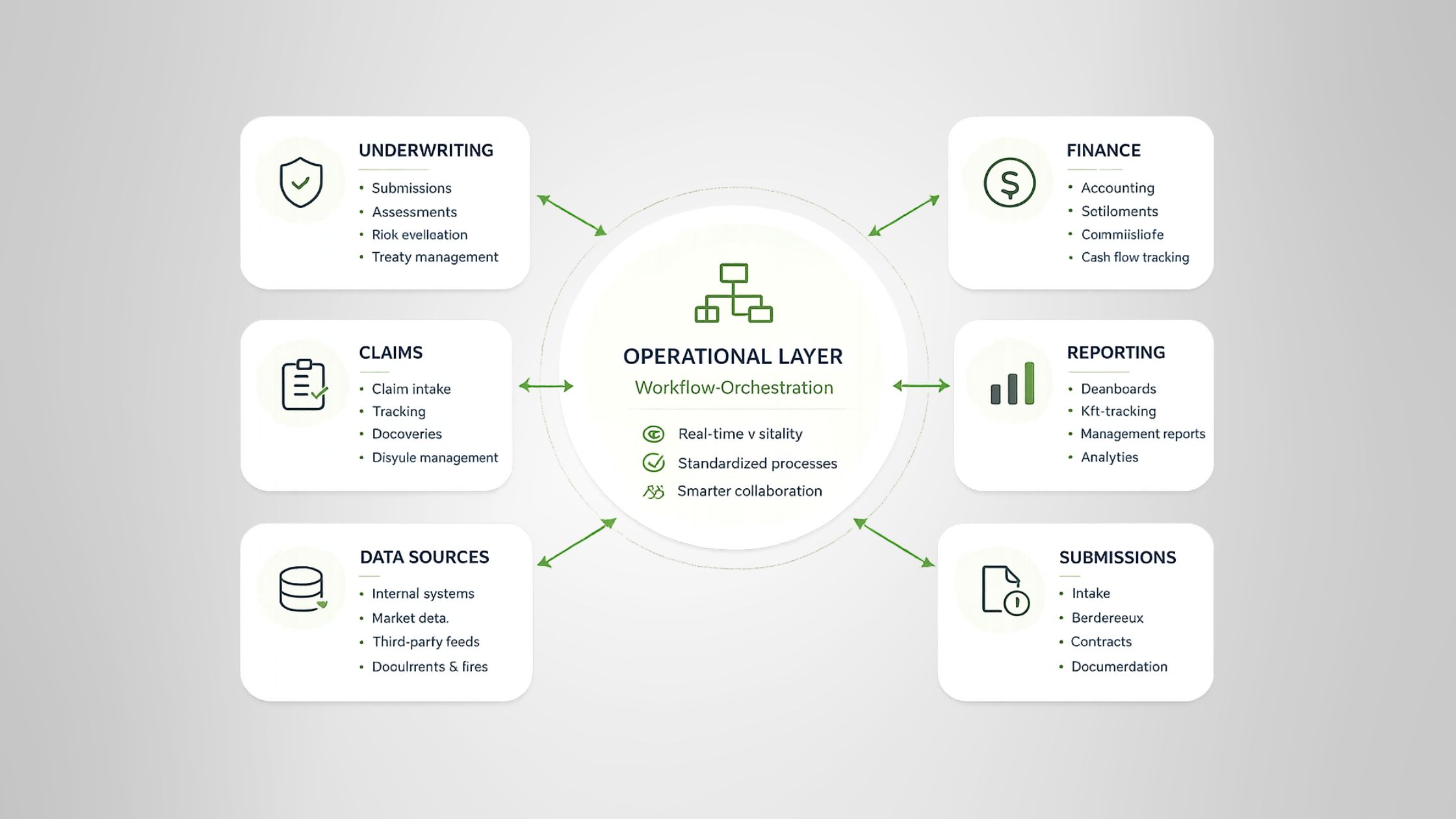
Most operational inefficiencies in reinsurance do not come from a single failure point. They come from fragmentation between processes.
This is why many organizations continue to struggle operationally even after investing heavily in technology. A reinsurance operations platform addresses several core challenges simultaneously.
Workflow visibility
Teams gain a clear operational view of submissions, claims, bordereaux, approvals, and reporting processes across the organization.
Instead of relying on manual updates, workflow status becomes visible in real time.
Structured intake and workflow routing
Submissions, claims updates, and operational requests move through defined workflows instead of fragmented communication channels.
Ownership becomes clear. Tasks move faster. Bottlenecks become easier to identify.
Reduced manual coordination
Teams spend less time following up through email, reconciling spreadsheets, or searching for missing information.
Operational effort shifts away from coordination and back toward decision-making.
Better operational scalability
As portfolios and reporting requirements grow, workflows remain manageable because structure replaces manual dependency.
This is one of the most important operational shifts happening in reinsurance today.
Why visibility is becoming a competitive advantage
Operational visibility is no longer just an efficiency metric. It is becoming a competitive advantage.
Organizations that can clearly see their workflows are able to:
- respond to brokers faster
- prioritize opportunities earlier
- reduce delays in claims handling
- improve reporting accuracy
- coordinate decisions more effectively
- identify operational bottlenecks before they escalate
In a market where responsiveness increasingly impacts relationships and growth, operational speed and visibility directly affect business performance.
This is one of the reasons workflow orchestration and operational platforms are gaining so much attention across insurance and reinsurance operations.
Why replacing core systems is not always the right strategy
When operational pressure increases, many organizations immediately consider replacing core systems. In reality, full system replacement projects are expensive, disruptive, and often slow to deliver value. More importantly, they do not always solve the underlying problem.
Most core systems are designed to process and store data within a specific function. They are not designed to coordinate workflows across multiple departments and operational processes.
This is why many reinsurers are now focusing on building operational structure around existing systems instead of replacing them entirely.
The goal is not to eliminate every legacy tool. The goal is to create visibility and workflow coordination between them.
The industry is moving from systems of record to systems of coordination
Historically, insurance technology focused primarily on systems of record. The market is now shifting toward systems of coordination.
This reflects a broader industry realization: storing data is no longer enough. Organizations also need operational infrastructure that helps teams manage how work moves across the business.
This is especially important in reinsurance, where workflows often span underwriting, claims, finance, reporting, brokers, cedents, and external partners simultaneously.
As operational complexity continues to increase, workflow coordination is becoming just as important as the underlying data itself.
Conclusion
The future of reinsurance operations will not be defined by more disconnected tools or more manual coordination. It will be defined by visibility, workflow structure, and operational control.
Organizations that continue relying on fragmented operational models will struggle to scale efficiently as complexity grows. Those that invest in structured operational workflows will move faster, respond earlier, and operate with greater clarity across the business.
The industry is reaching a point where operational infrastructure matters as much as underwriting expertise.
This is why reinsurance operations platforms are becoming essential.